Wholesale Pachypodium from China: Sizes, Roots & Specimens
Source wholesale Pachypodium from China with clear botanical labels, base measurements, root conditions and specimen grades. Build a precise nursery inquiry.
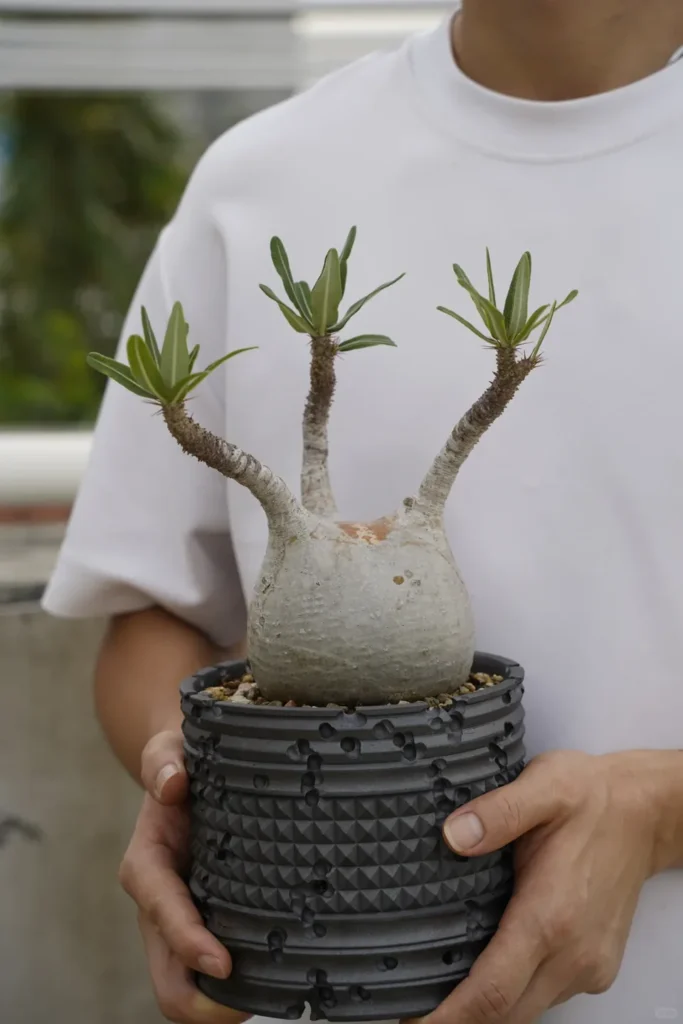
Buying wholesale Pachypodium from China starts with a clear description of the plant you expect to receive. Two plants carrying the same nursery name can differ in trunk shape, branch structure, rooting history and the work needed before retail sale. A quoted pot size alone does not explain those differences.
Use this guide to build an order sheet for seedlings and larger specimens. Browse the featured plant catalogue and search for Pachypodium to build a shortlist, then ask for the identity and specifications of each proposed order line. Catalogue entries help organize an inquiry; a supplier’s batch evidence is needed to evaluate the actual offer.
Resolve the botanical name before choosing a grade
Record the botanical name, supplier item code and any trade name together. The catalogue includes labels such as Pachypodium densiflorum, P. baronii, P. brevicaule and P. eburneum, alongside rosulatum-related selections and a listed hybrid. Keep these as separate buying lines rather than ordering an unspecified “mixed Pachypodium” assortment.
Ask the supplier to clarify spelling, infraspecific names and hybrid parentage where relevant. Copying a shortened nursery label onto an invoice can leave the receiving team unsure which selection was agreed. For a hybrid, retain the supplier’s parentage description and distinguish it from a species name. Do not infer a precise identification from trunk color or a photograph alone.
Also separate cultivation location from origin information. Ask what propagation and provenance records accompany the offered plants. A sourcing location does not by itself establish how a plant was propagated or all information needed for an international shipment.
Separate seedlings, established plants and rooting projects
Decide whether your nursery needs smaller plants to grow on, established retail-ready forms or individually selected specimens. Describe those commercial goals using measurable criteria rather than relying on “premium,” “old” or “large.” Ask what evidence supports claims about age or propagation history.
For every line, request the propagation method and current root condition. Keep established rooted plants, recently rooted material, unrooted plants and grafted material separate if offered. For grafted plants, request the rootstock identity and union photographs. A container filled with growing medium does not establish that the plant has a developed root system.
Tell the supplier whether your team can accommodate a rooting or recovery phase. Agree on the condition at dispatch and the evidence you will review; avoid treating an attractive above-ground shape as proof of readiness for immediate retail display.
Measure the swollen base and the overall plant separately
Define where each measurement is taken. For the swollen trunk or caudex, request the widest visible body diameter, excluding the pot and projecting spines. If the base is partly buried, ask which part is visible and whether another measurement can be documented without unnecessary disturbance.
Record body height, total height and branch spread as separate fields where they affect display or packing. A compact branched plant and a tall single-stem plant can share a base diameter while requiring different handling. Keep pot diameter as an additional container field.
| Buying field | Agreed definition | Evidence to request |
|---|---|---|
| Identity | Botanical label, hybrid details and item code | Readable label linked to the plant or batch |
| Base size | Widest visible body diameter; stated measuring point | Ruler view with the base unobscured |
| Plant height | Body height and total height if needed | Side view beside a ruler |
| Branch form | Branch-count range, spread and accepted asymmetry | Front and opposite-side photographs |
| Root condition | Established, recently rooted, unrooted or grafted | Recent root evidence appropriate to the agreed format |
| Appearance | Accepted scars, marks and branch damage | Close views of ordinary and lower-limit examples |
An example inquiry might specify “branched plants with a quoted base-diameter band, measured above the medium, and separate total-height and branch-spread ranges.” This describes how to request a grade; it is not a grade currently offered by the website.
Agree on shape and visible condition
Choose the features that matter to your intended customers: a compact base, a balanced branch structure, a particular silhouette or smaller plants suitable for growing on. Explain acceptable variation within the batch. Individual specimen approval may suit distinctive forms, while a defined range may suit a nursery assortment.
Request close views of scars, damaged tips and the base-to-medium boundary. Ask the seller to describe any recent pruning, repotting or other preparation relevant to the offered condition. These questions help you interpret the photographs without making a remote diagnosis.
Record whether photographs show a leafy or leafless plant and when they were taken. Leaf appearance is one observation, not a complete acceptance test. Ask about the plant’s recent condition and review roots, body and growing points together before deciding what evidence is still missing.
Match photographs to the selling unit
For individually selected specimens, give every approved plant a code and match that code to the quotation. For a size-graded batch, request an overview plus ordinary, smallest-accepted and largest-accepted examples. Agree on how the supplier will select plants within the stated range.
Keep a photo register with the order line, date, dimensions and approval status. Use our batch photo checklist for a practical evidence sequence, adapting the body measurements to Pachypodium. Changes to plant form, quantity or substitution should receive a new written approval.
Compare the full preparation and delivery scope
Compare quotations only after identity, root format, measurement bands and the selection method align. Ask whether the selling unit is one plant, one individually approved specimen or an assortment assembled to a grade. State the requested quantity for each line.
Request separate plant, preparation, packing, documentation and transport costs where applicable. Identify the destination and which party handles each part of the route. The wholesale quotation comparison guide provides a reusable cost sheet. For a first order, use the trial-order guide to assess selection accuracy and your receiving process before expanding the assortment.
Check the exact U.S. import route before committing
APHIS directs importers to check requirements by commodity and country of origin through ACIR. Review the exact botanical identities, origin and shipment form using the official APHIS import guidance. Confirm the importer and applicable permits, certificates, inspection arrangements and protected-plant requirements for the actual order.
The APHIS permit guidance also addresses protected plants. A genus name, nursery photograph or sourcing country alone is insufficient to settle a shipment’s eligibility or documentation.
Send a specification-led Pachypodium inquiry
Please quote my Pachypodium shortlist by botanical label and item code. For each line, confirm propagation history, root condition, base-diameter band and measuring point, body and total height, branch form, accepted cosmetic marks and quantity. Include dated batch or individual photographs linked to those lines, with preparation, packing, documents and freight itemized for our destination.
Add your business type and whether the plants are for growing on or specimen retail, then request a wholesale quotation. Clear selection criteria make the next conversation more useful.
Frequently asked questions
Can I compare Pachypodium using pot diameter?
Use pot diameter as a container measurement. Compare the base, height, branch form and root condition separately.
Does a leafless photograph prove poor condition?
It does not establish the full condition. Request recent context and additional body, growing-point and root evidence before approving the plant.
Should every specimen be individually approved?
Individual codes suit distinctive specimens. For a graded nursery batch, agree on measurable ranges, representative evidence and the selection method.